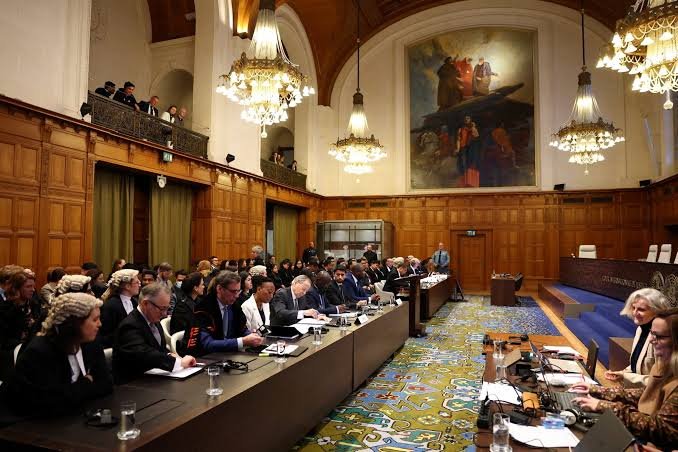
THE HAGUE, November 19 (Aalimi Nation) – The International Court of Justice (ICJ) is due to deliver its judgment today in the genocide case brought by The Gambia against Myanmar over the treatment of the Rohingya, a ruling that could set a landmark in international law.
The court, the principal judicial organ of the United Nations, will read its decision at the Peace Palace in The Hague at 10:00 local time (09:00 GMT, or 2:30 pm in India). The reading is expected to take up to 90 minutes. The outcome had not been announced at the time of writing.
ICJ Rohingya genocide case: what is at stake
The Gambia, a Muslim-majority West African country, filed the case in November 2019 with the backing of the Organisation of Islamic Cooperation. It argues that Myanmar is responsible for genocide arising from a military offensive in 2017 that forced at least 730,000 Rohingya, most of them Muslims, to flee to Bangladesh.
Survivors have described killings, mass rape and the burning of villages. A UN fact-finding mission previously concluded that the campaign included acts of a genocidal nature.
The Gambia has asked the court to order Myanmar to prosecute those responsible, to pay reparations, and to ensure that the Rohingya can return safely to their homes.
Myanmar denies the charge. It says its forces responded lawfully to attacks by armed groups, and argues that there is no direct evidence of an intent to destroy the Rohingya as a group. It has also disputed The Gambia's right to seek reparations on behalf of the victims.
The legal test
Under the 1948 Genocide Convention, a finding of genocide requires proof of a specific intent to destroy a national, ethnic, racial or religious group, in whole or in part. That standard is widely regarded as difficult to meet.
The ICJ has never held a state responsible for committing genocide. In 2007, it found that Serbia had failed to prevent the 1995 Srebrenica massacre but ruled that Serbia had not itself committed genocide. The court settles disputes between states and cannot prosecute individuals; that task belongs to the International Criminal Court.
The case moved to the merits stage after the court rejected all of Myanmar's preliminary objections on jurisdiction in July 2022.
Where the Rohingya live today
About 1.2 million Rohingya live in refugee settlements in Cox's Bazar in Bangladesh. Roughly 550,000 remain in Myanmar, where, according to the case record described by observers, their movement, access to healthcare and livelihoods are restricted.
What happens next
The judgment is final and cannot be appealed. The court has limited means of enforcing it. If Myanmar does not comply, The Gambia could ask the UN Security Council to take action.
Whatever the court decides, the ruling is expected to be closely studied by governments and legal scholars for how it applies the intent requirement under the Genocide Convention. Aalimi Nation will report the ruling as details are confirmed.